

Automated Infrastructure Assessment
LiDAR for Bridge & Road Inspection
Infrastructure agencies manage thousands of bridges and miles of roadway. Drone LiDAR offers a faster, safer, more comprehensive approach to documentation than traditional visual assessment and manual surveying.
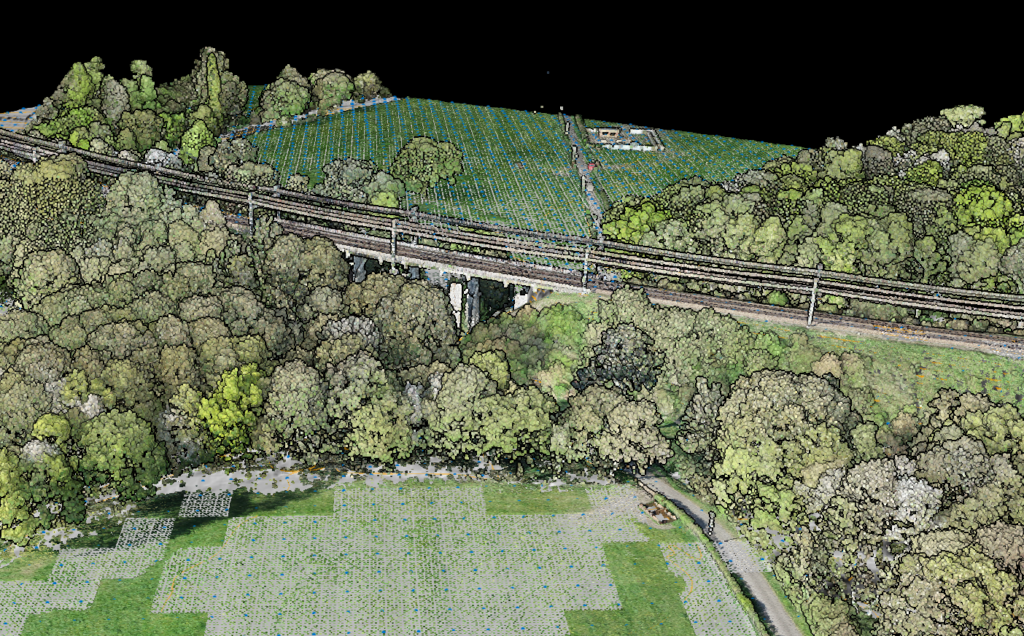
Why LiDAR for Transportation Infrastructure
Bridges and roads exist in complex environments—over waterways, through forests, alongside utilities. LiDAR captures all of this context in a single dataset.
Bridge Inspection Deliverables
Bridge Deck Classification
Lidarvisor automatically classifies bridge deck surfaces, enabling:
• Surface analysis for flatness and grade
• Clearance measurement to waterway below
• Volume calculations for deck replacement planning
• Change detection comparing surveys over time
Digital Terrain Model (DTM)
The terrain beneath and surrounding bridges is critical for:
• Scour analysis near abutments
• Approach grading design
• Drainage planning
• Embankment stability monitoring
Road Corridor Deliverables
- Classified Point Cloud — with bridge deck separated from terrain
- DTM Raster — GeoTIFF for terrain analysis
- Contour Lines — DXF at engineering-grade intervals (0.25m-0.5m)
- Slope Map — for drainage and stability analysis
Traditional Inspection
- ❌ Requires lane closures and traffic control
- ❌ Limited to what inspectors can see and reach
- ❌ Subjective condition ratings
- ❌ No quantitative dimensional data
LiDAR-Based Inspection
- ✅ Minimal traffic disruption
- ✅ Complete coverage including inaccessible areas
- ✅ Quantitative measurements for change detection
- ✅ Permanent record for comparison over time
Create a FREE account now and start processing your point cloud
Get 2 GB of storage space and classify up to 10 hectares for free.