How to Download Free LiDAR Data from Scotland

Access high-quality elevation data from the Scottish Remote Sensing Portal — free for commercial and non-commercial use

What is the Scottish Remote Sensing Portal?

The Scottish Remote Sensing Portal is a collaborative initiative between the Scottish Government and the Joint Nature Conservation Committee (JNCC). It provides free access to airborne LiDAR data collected across Scotland by various public sector organizations.

Key Features

  • 47+ datasets covering different regions and time periods
  • Multiple phases of data collection (Phase I through VI, plus specialized projects)
  • Point cloud and raster products including DTM, DSM, and LAZ files
  • 10 km tile downloads aligned to the British National Grid
  • WMS web services for direct integration into GIS applications
  • Free for most uses under the Open Government Licence v3
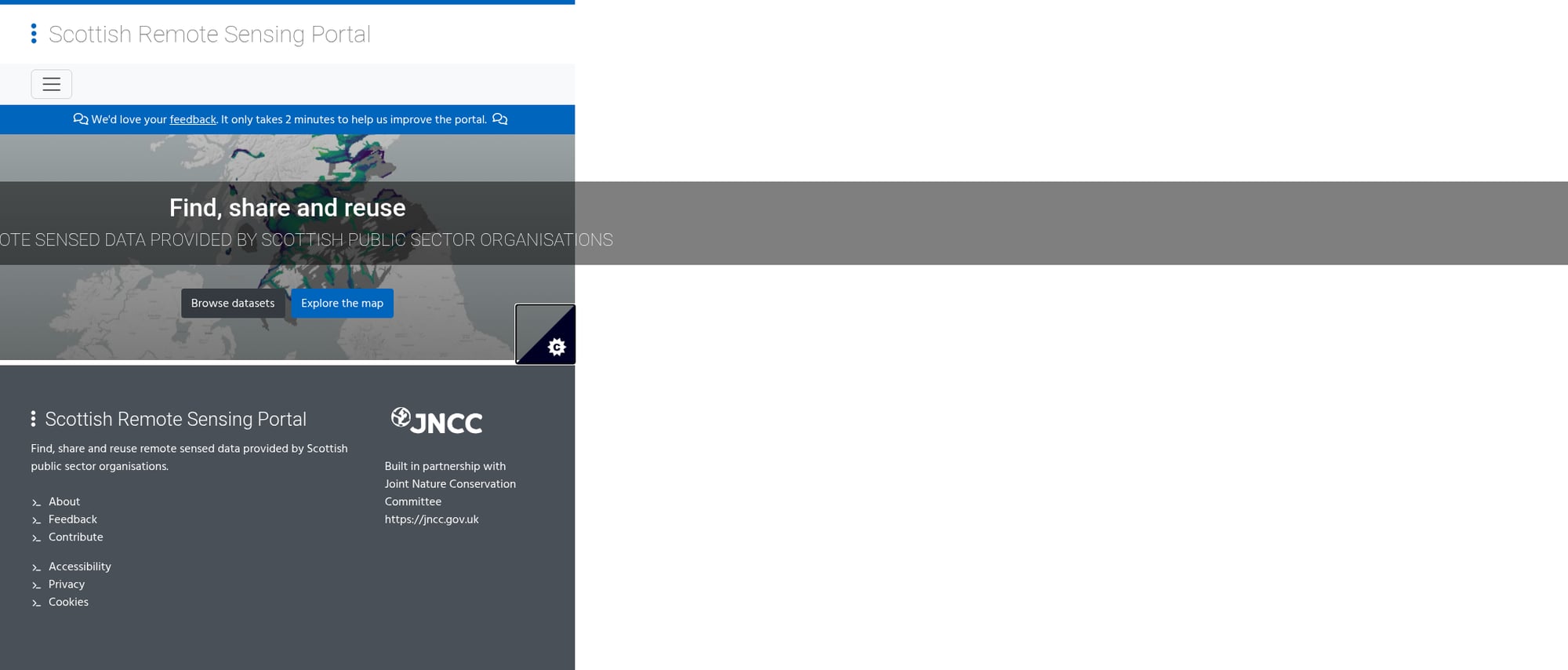
Scottish Remote Sensing Portal homepage with navigation buttons

Coverage Overview

The portal contains data from multiple collection phases:

Phase I: 2011–2012 | 11,845 km²
Phase II: 2012–2014 | 3,516 km²
Phase III: 2015–2016 | 11,772 km²
Phase IV: 2017–2019 | 17,945 km²
Phase V-VI: 2020–2022
NLP 2025: National Coverage

Note: The Scottish Land LiDAR Programme (NLP) aims to provide complete national coverage of Scotland between 2025 and 2027 at 10 points per square metre resolution.

Step-by-Step Download Guide

01

Access the Portal

Visit remotesensingdata.gov.scot and click on “Browse datasets” to see all available data, or “Explore the map” for the interactive tile selector.

02

Select Your Dataset

Use the left panel to choose which dataset(s) you want:

  • Phase datasets (I–VI) for general coverage
  • HES datasets for Historic Environment Scotland sites (higher resolution: 0.25–0.5m)
  • NLP 2025 for the newest national programme data
  • Outer Hebrides 2019 for island coverage

Select the product type for each dataset:

  • DSM – Digital Surface Model (includes buildings/vegetation)
  • DTM – Digital Terrain Model (bare earth)
  • LAZ – Compressed point cloud data
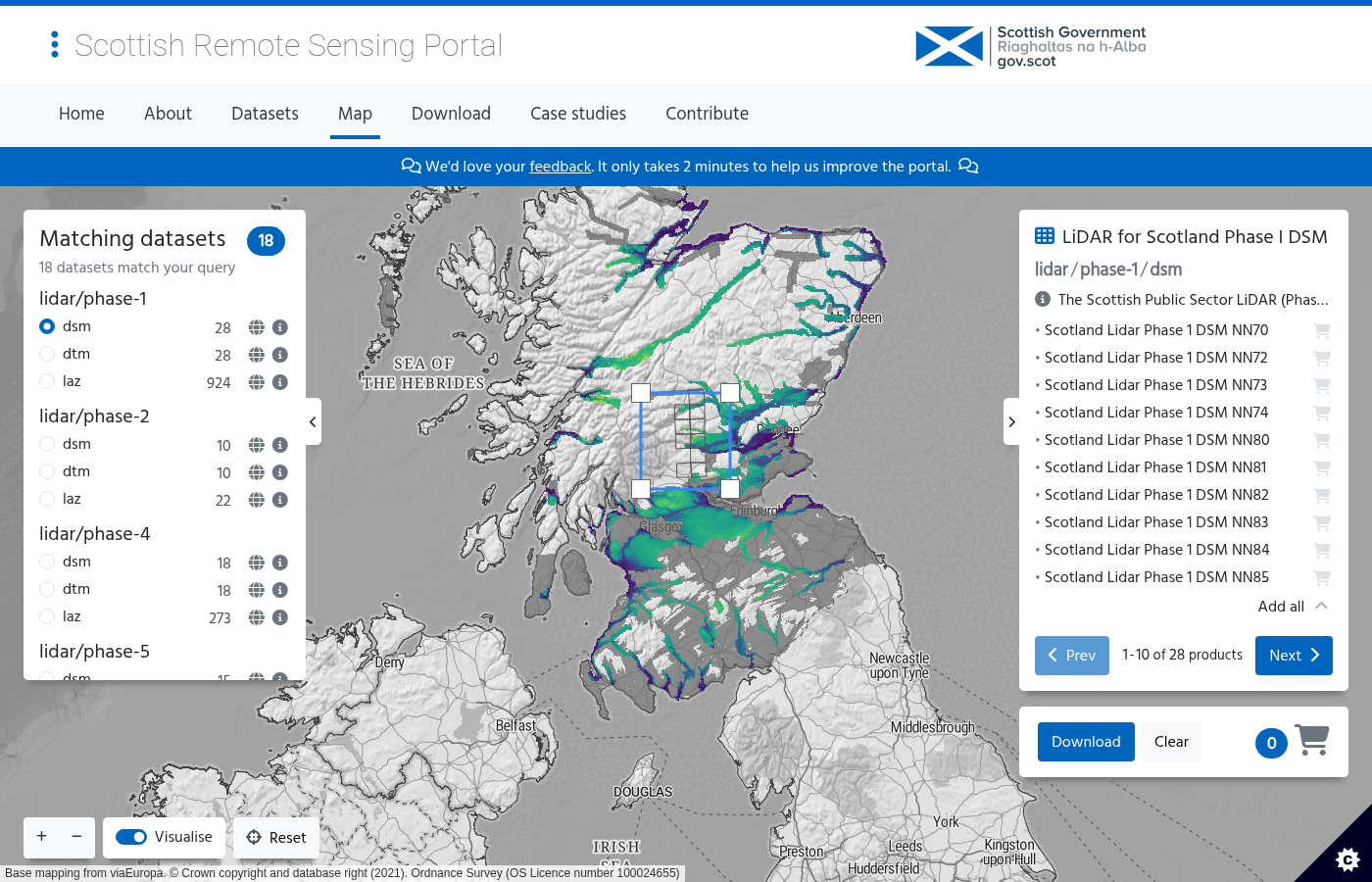
Interactive map showing LiDAR data coverage across Scotland
03

Select Tiles on the Map

The data is organized into 10 km × 10 km tiles aligned to the British National Grid:

  1. Navigate to your area of interest using zoom and pan controls
  2. The right panel shows available tiles for your selected dataset
  3. Click the basket icon next to each tile to add it to your download basket
  4. The basket counter at the bottom right shows how many tiles you’ve selected
04

Download Your Data

  1. Click the “Download” button in the bottom right corner
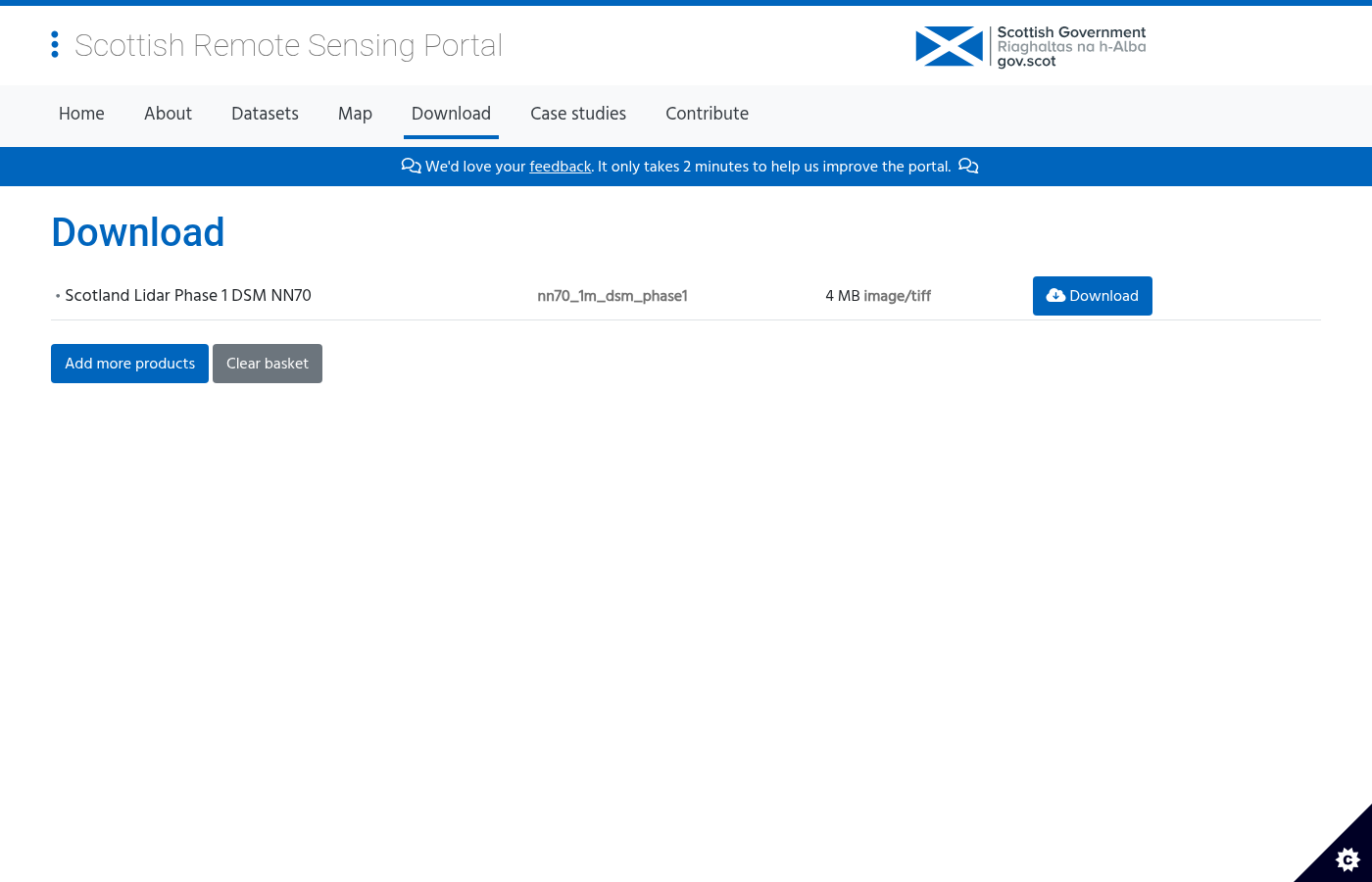
  2. Review your basket contents showing tile names, filenames, and file sizes
  3. Click the Download button next to each file to get your data

No account registration is required—downloads are immediate and free!

Download basket showing selected LiDAR tiles ready for download

Available File Formats

LAZ Point Cloud

Compressed LAS format with full point data. 80–90% smaller than uncompressed LAS. File sizes: 50–200 MB per tile.

DTM (GeoTIFF)

Digital Terrain Model showing bare earth elevation. Ideal for hydrological analysis and terrain studies. File sizes: 5–20 MB per tile.

DSM (GeoTIFF)

Digital Surface Model including buildings and vegetation. Perfect for urban planning and forestry. File sizes: 5–20 MB per tile.

Coordinate System: All data is provided in British National Grid (EPSG:27700), the standard coordinate reference system for Great Britain.

Tips for Large Downloads

Plan Your Coverage

Use the Datasets list to understand what coverage is available for your area. Not all areas have data from every phase.

Check Metadata

Each dataset has a Metadata link to the Scottish Spatial Data Infrastructure catalog. Review for detailed specifications, collection dates, and accuracy information.

Use WMS for Preview

The portal provides WMS endpoints for each dataset. Click the “WMS” button to get the service URL for previewing in QGIS, ArcGIS, or other GIS software.

Download in Batches

For large areas, download tiles in batches. Start with DTM/DSM files (smaller) before point clouds. Consider using a download manager for multiple files.

Processing Scottish LiDAR in Lidarvisor

Once you have downloaded your LiDAR data, Lidarvisor makes it easy to visualize and process your files:

  1. Upload your LAZ files directly to Lidarvisor for instant 3D visualization
  2. View DTM/DSM rasters alongside point clouds for comparison
  3. Generate derived products like hillshades, contours, and slope maps
  4. Merge multiple tiles into seamless coverage of your study area
  5. Export processed data in your preferred format

The British National Grid coordinate system (EPSG:27700) is fully supported, so your Scottish data will load with correct georeferencing.

Frequently Asked Questions

Yes. Most datasets are licensed under the Open Government Licence v3, which allows free use for commercial and non-commercial purposes with attribution. Some Historic Environment Scotland datasets use the Non-Commercial Government Licence, which restricts commercial use—check the licence icon on each dataset.

Not yet. Earlier phases (I–VI) cover specific areas totaling approximately 45,000 km², primarily focused on flood risk zones, power network corridors, and heritage sites. However, the Scottish Land LiDAR Programme (NLP) that began in 2025 aims to provide complete national coverage by 2027 at 10 points per square metre.

Accuracy varies by dataset and phase. Generally, you can expect:

  • Vertical accuracy: ±5–15 cm RMSE for most datasets
  • Horizontal accuracy: ±20–50 cm
  • Point density: 4 points/m² (phases III–VI) to 10 points/m² (NLP 2025)

Check the metadata for each specific dataset for exact specifications.

No. The Scottish Remote Sensing Portal allows immediate downloads without registration. Simply select your tiles on the map and download.

Yes. Each dataset provides a WMS endpoint for direct integration into GIS applications. Click the “WMS” button next to any dataset in the list view to get the service URL. This is useful for previewing coverage before downloading or for applications that can work with streaming data.

Ready to Process Your Scottish LiDAR Data?

Upload your downloaded files to Lidarvisor for instant visualization, analysis, and export.