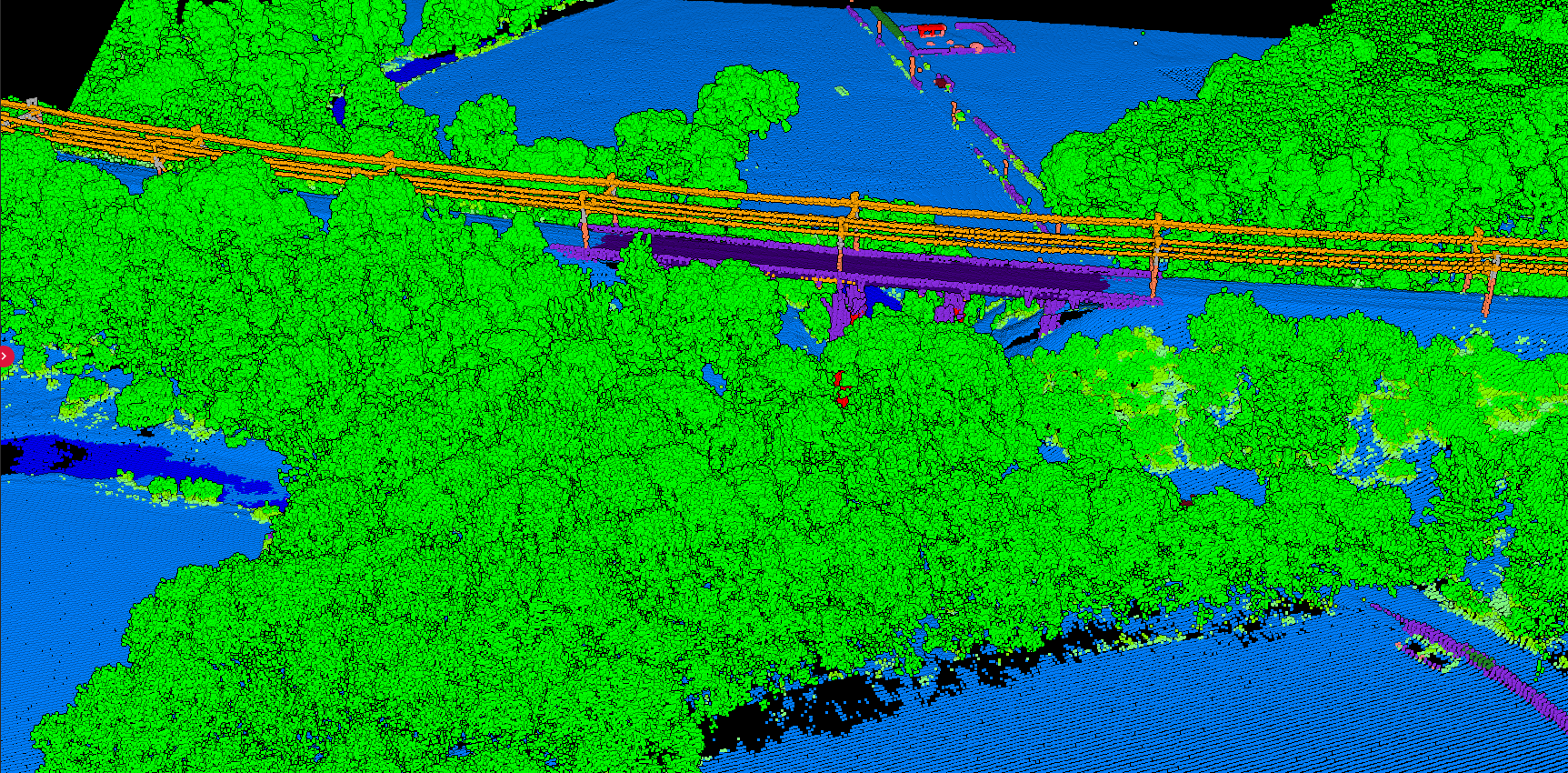
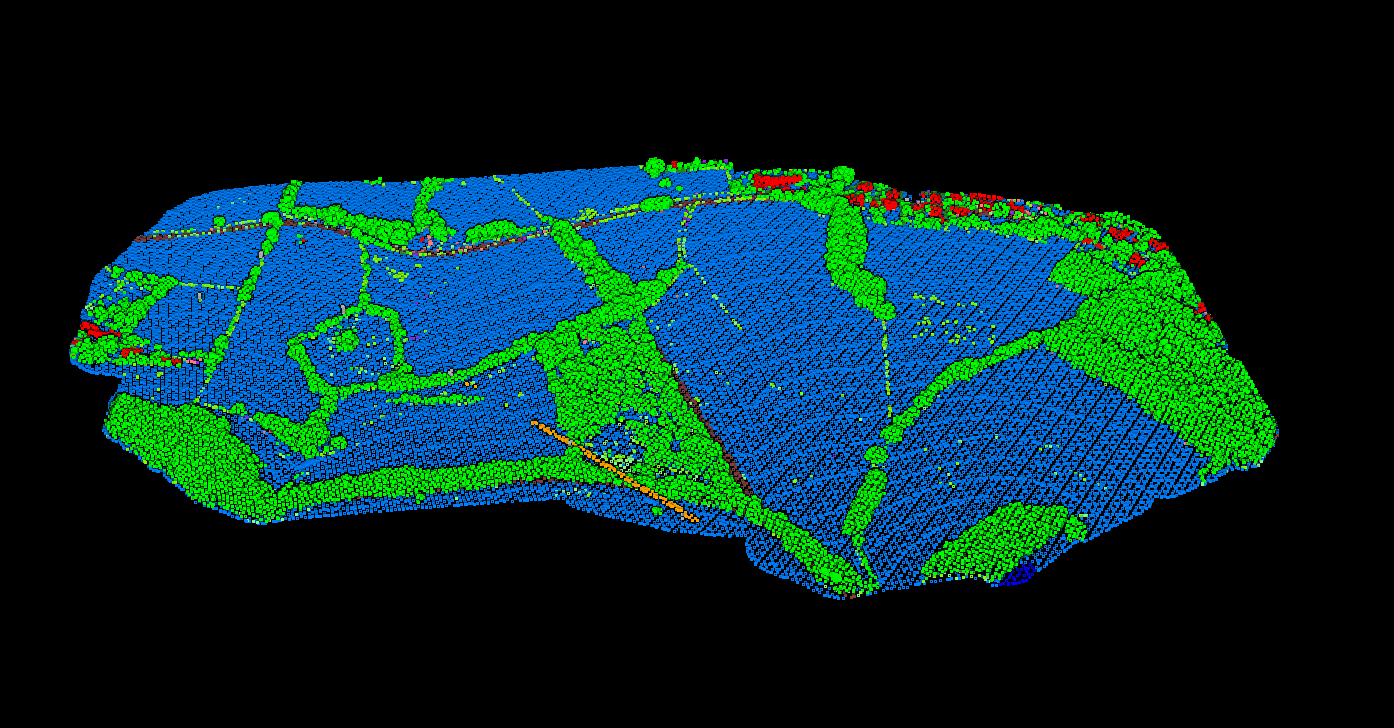
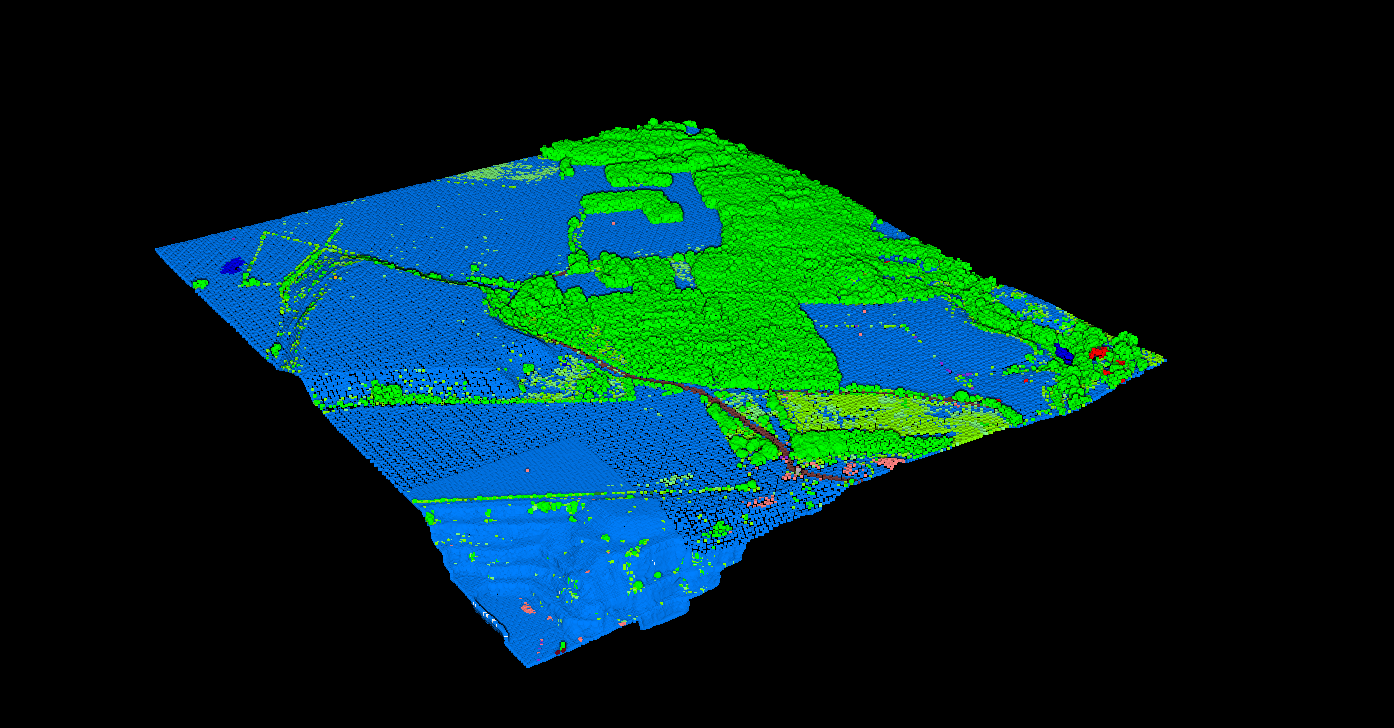
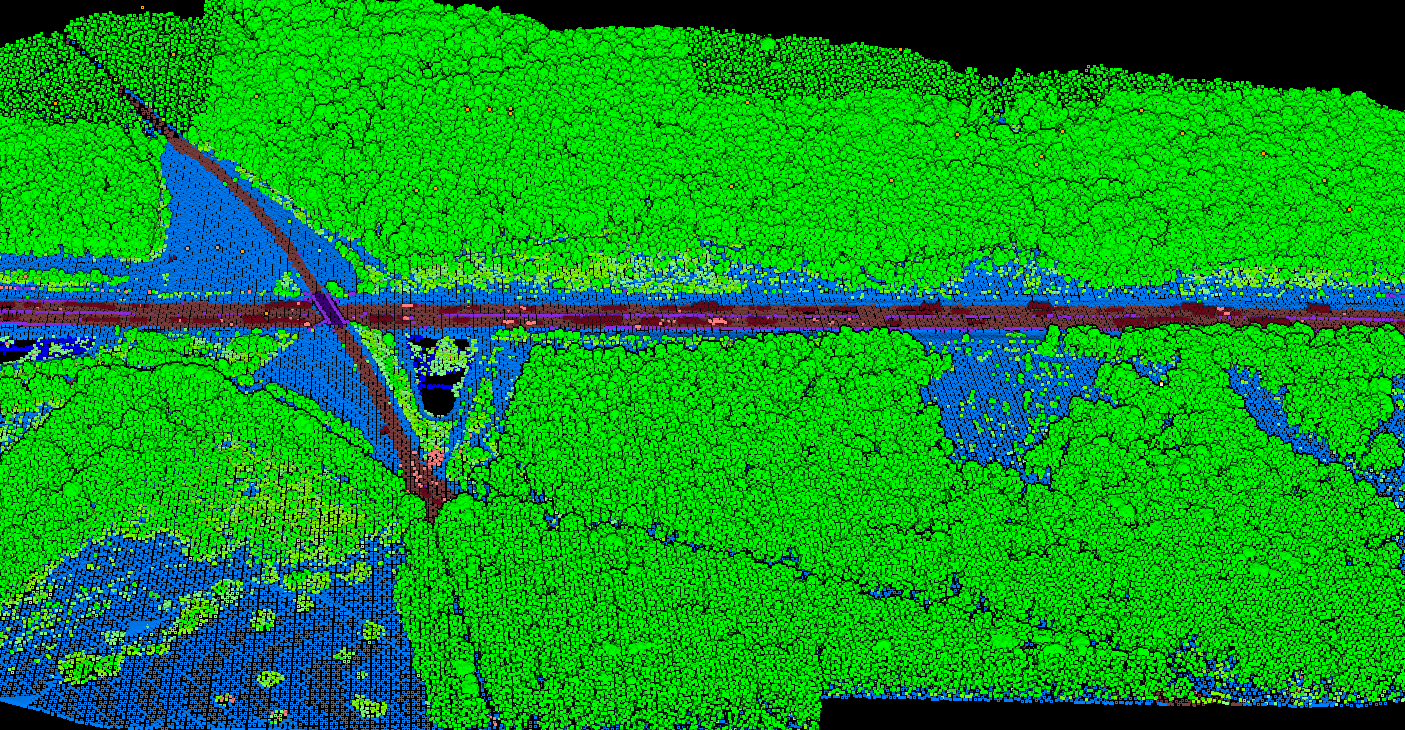
LiDAR classification is the process of assigning category labels to individual points in a point cloud dataset. Each point receives a numeric code identifying what type of object or surface it represents — ground, vegetation, building, water, power line, or other features.
Classification transforms raw, undifferentiated point clouds into semantically meaningful data. Without classification, a point cloud is simply millions of XYZ coordinates. With classification, it becomes an organized dataset where you can isolate ground points for terrain modeling, extract buildings for urban mapping, or identify vegetation for forestry analysis.
The classification information is stored within LAS/LAZ files as an integer attribute for each point, following standards established by the American Society for Photogrammetry and Remote Sensing (ASPRS).
ASPRS Standard Classification Codes
The LAS file format defines standard classification codes that ensure interoperability across software and organizations:
Core Classes (LAS 1.1-1.4)
| Code |
Class Name |
Description |
| 0 |
Created, Never Classified |
Default for new points |
| 1 |
Unclassified |
Processed but unassigned |
| 2 |
Ground |
Bare earth surface |
| 3 |
Low Vegetation |
Grass, crops (0-0.5m) |
| 4 |
Medium Vegetation |
Shrubs (0.5-2m) |
| 5 |
High Vegetation |
Trees (>2m) |
| 6 |
Building |
Structures and rooftops |
| 7 |
Low Point (Noise) |
Erroneous returns |
| 9 |
Water |
Lakes, rivers, oceans |
| 10 |
Rail |
Railway tracks |
| 11 |
Road Surface |
Paved roads |
| 14 |
Wire – Conductor |
Power line conductors |
| 15 |
Transmission Tower |
Electrical towers |
| 17 |
Bridge Deck |
Bridge surfaces |
LAS version 1.4 expanded classification support to codes 0-255, enabling custom classes for specialized applications like vehicles, fences, poles, and signs.
The Classification Workflow
Effective classification follows a specific sequence where each step builds on previous results.
Step 1: Noise Classification
Always classify noise first. Outlier points corrupt subsequent algorithms. Types of noise include high noise (bird strikes, aircraft, atmospheric particles), low noise (multipath errors, subsurface returns), and isolated points with no nearby neighbors.
Step 2: Ground Classification
Ground classification is foundational. Building and vegetation classification require knowing where the ground is to calculate heights above ground.
Common algorithms include:
- Progressive TIN Densification: Builds triangulated surface iteratively — general terrain, widely used
- Cloth Simulation Filter (CSF): Simulates cloth draping over inverted cloud — varied terrain, steep slopes
- Morphological Filter (SMRF): Applies morphological operations — gentle terrain
- Slope-based Filter: Removes points exceeding slope thresholds — mountainous areas
Step 3: Building Classification
Once ground is established, algorithms identify buildings based on height above ground, planar surfaces, curvature analysis, and geometric regularity. Buildings are typically Class 6.
Step 4: Vegetation Classification
Vegetation classification separates points into height strata:
- Class 3 (Low): 0-0.5m above ground (grass, crops)
- Class 4 (Medium): 0.5-2m above ground (shrubs)
- Class 5 (High): >2m above ground (trees)
Distinguishing vegetation from buildings relies on scattered point patterns with high curvature variation versus planar surfaces with consistent normals.
Step 5: Infrastructure Classification
Specialized classes for linear infrastructure include power lines (Classes 13-16), rail (Class 10), road surface (Class 11), and bridge deck (Class 17).
Step 6: Manual Review and Correction
Automated classification rarely achieves 100% accuracy. Manual review addresses building edges misclassified as vegetation, vegetation points incorrectly labeled as ground, and unique features not matching standard classes.
Rule-Based Classification
Traditional approach using geometric and statistical rules. Predictable and interpretable results with no training data required, but requires parameter tuning per project and struggles with complex scenes.
Machine Learning Classification
Statistical models trained on labeled examples using algorithms like Random Forest, Support Vector Machines (SVM), and AdaBoost. Adapts to data characteristics and handles complex feature combinations, but requires labeled training data.
Deep Learning Classification
Neural networks processing point clouds directly. Key architectures include:
- PointNet: Directly processes unordered point sets
- PointNet++: Hierarchical feature learning
- KPConv: Kernel point convolutions for 3D
- RandLA-Net: Efficient large-scale processing
Deep learning learns features automatically and achieves state-of-the-art accuracy, but requires large labeled datasets and GPU hardware.
Classification for Specific Applications
Terrain Modeling
Requires Class 2 (Ground) with complete ground coverage under vegetation and correct handling of bridges. Ground points are used to generate a Digital Terrain Model (DTM) representing bare-earth elevation.
Urban Mapping
Requires Classes 2 and 6 (Ground and Building) with clean building/vegetation separation and accurate footprint edges. A Digital Surface Model (DSM) captures the top of buildings and other above-ground features.
Forestry Analysis
Requires Classes 2-5 (Ground plus vegetation strata) with accurate canopy height and vegetation stratification.
Power Line Inspection
Requires Classes 13-16 (Wire, Tower, Connector) with complete conductor detection and vegetation near wires flagged.
Frequently Asked Questions
What is the difference between LiDAR classification and segmentation?
Classification assigns semantic labels (ground, building, vegetation) to points. Segmentation groups points into distinct objects (individual trees, separate buildings) without necessarily identifying what they are. Classification tells you what a point is; segmentation tells you which object it belongs to.
How accurate is automated LiDAR classification?
Accuracy varies by class and scene complexity. Ground classification typically achieves 95-99% accuracy in open terrain, lower in dense vegetation. Building classification reaches 90-95% in urban areas. Deep learning methods achieve state-of-the-art results but require quality training data.
Why is ground classification done first?
Ground classification establishes the reference surface for all other classes. Building height, vegetation stratification, and above-ground features are all defined relative to ground elevation. Without accurate ground classification, subsequent classes will have errors.
What causes misclassification?
Common causes include dense vegetation preventing ground detection, complex building geometries, low point density, scanner artifacts, and algorithm limitations. Manual review and correction address residual errors.
LiDAR classification transforms raw point clouds into actionable geospatial data. Understanding the ASPRS standard classes, following proper classification sequences, and selecting appropriate algorithms ensures accurate results for terrain modeling, urban mapping, forestry, and infrastructure applications.
Modern classification increasingly leverages machine learning and deep learning to handle complex scenes that challenge rule-based methods. However, the fundamental workflow — noise removal, ground classification, above-ground feature separation — remains consistent regardless of the underlying algorithms.
Need classified LiDAR data? LidarVisor automatically classifies aerial point clouds into ground, vegetation, buildings, and infrastructure classes using advanced machine learning. Upload your LAS or LAZ file and get classified data ready for DTM generation and feature extraction.