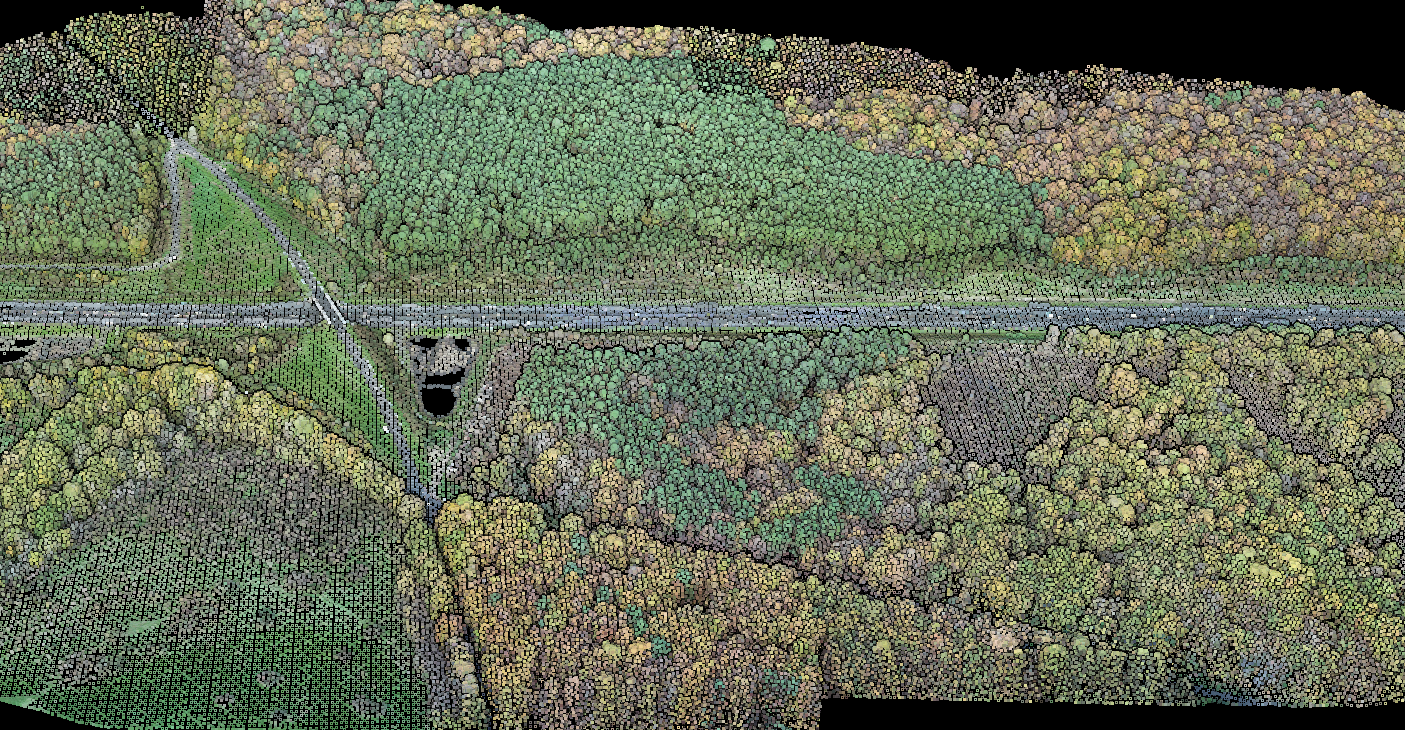
LiDAR data acquisition is the process of capturing three-dimensional spatial information using laser scanning technology. The system emits rapid laser pulses toward a target surface, measures the time it takes for each pulse to return, and calculates precise distances to create dense point clouds representing the environment.
This active remote sensing method provides unique advantages over passive technologies like photography: it works in low-light conditions, penetrates vegetation canopy to reach the ground, and delivers centimeter-level accuracy for elevation measurements.
Whether you are mapping terrain for flood risk assessment, surveying power line corridors, or creating digital twins of urban environments, understanding the data acquisition process is essential for project success.
Types of LiDAR Data Acquisition Systems
Airborne LiDAR Systems (ALS)
Airborne LiDAR remains the standard for large-scale mapping projects. Mounted on manned aircraft or helicopters, these systems capture data across hundreds of square kilometers in a single flight mission.
Key specifications for modern ALS systems:
- Point density: 5-30 points/m²
- Vertical accuracy: 5-10 cm
- Horizontal resolution: ~20 cm
- Pulse repetition rate: 2 MHz or higher
Leading manufacturers like Leica Geosystems, RIEGL, and Teledyne Geospatial produce sensors using Nd:YAG lasers at 1064 nm wavelength, optimized for terrain mapping and vegetation penetration.
Best suited for:
- National elevation programs
- Corridor mapping (highways, railways, pipelines)
- Large-area forestry inventory
- Coastal zone mapping
UAV/Drone LiDAR Systems
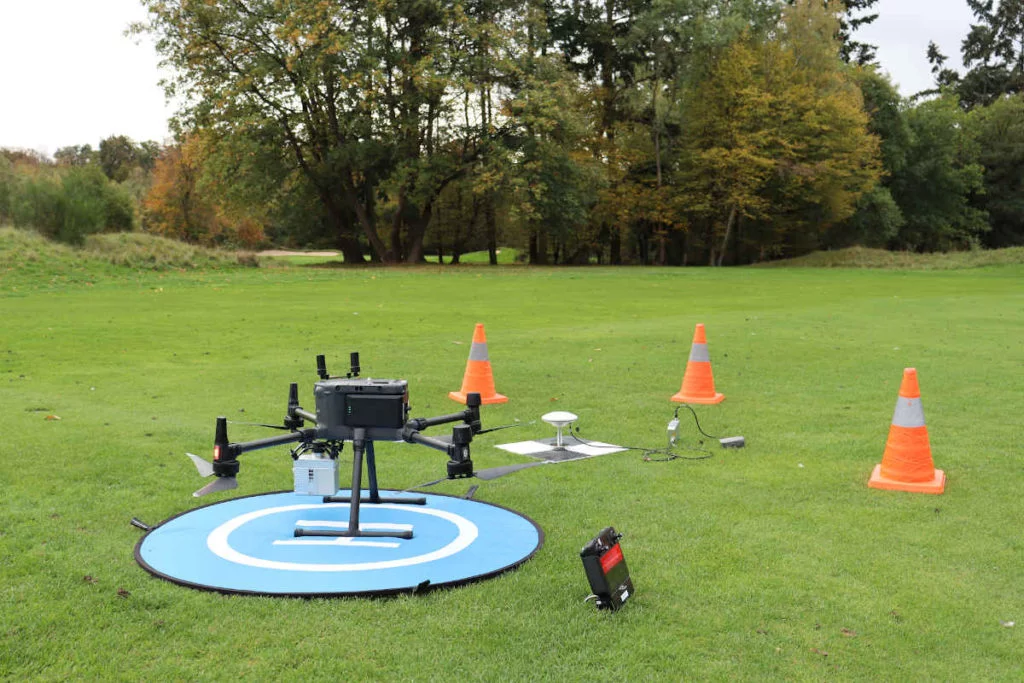
Drone-based LiDAR has transformed data acquisition for medium-scale projects. These systems combine the accuracy of laser scanning with the flexibility and lower cost of unmanned aerial vehicles.
Advantages of drone LiDAR:
- Lower mobilization costs than manned aircraft
- Access to difficult terrain
- Higher point density at lower altitudes
- Rapid deployment for time-sensitive projects
Typical specifications:
- Point density: 50-500 points/m²
- Flight altitude: 50-120 meters AGL
- Coverage: 50-500 hectares per day
- Vertical accuracy: 3-5 cm with ground control
Terrestrial Laser Scanning (TLS)
Ground-based scanners capture extremely dense point clouds from fixed positions. While coverage area is limited compared to airborne methods, TLS delivers unmatched detail for localized surveys.
Common applications:
- Building facade documentation
- Heritage site preservation
- Industrial plant surveys
- Forensic scene reconstruction
Mobile Laser Scanning (MLS)
Vehicle-mounted systems acquire data along road corridors while driving. This method efficiently captures linear infrastructure including roads, railways, and utility networks.
The LiDAR Data Acquisition Workflow
Step 1: Project Planning
Successful acquisition begins with thorough planning. Define your project requirements:
Coverage and accuracy requirements:
- What area needs to be surveyed?
- What vertical and horizontal accuracy is required?
- What point density meets your analysis needs?
Environmental considerations:
- Vegetation conditions (leaf-on vs. leaf-off)
- Weather constraints (precipitation, wind, visibility)
- Airspace restrictions and flight permits
Timing optimization:
- Leaf-off conditions improve ground penetration for terrain mapping
- Low-flow river conditions maximize floodplain coverage
- Solar angle affects shadow patterns in derived products
Step 2: Equipment Configuration
Select and configure hardware appropriate for your project scope:
Core components:
- LiDAR sensor unit
- GNSS receiver for positioning
- Inertial Measurement Unit (IMU) for orientation
- Data storage and logging system
Calibration requirements:
- Boresight calibration aligns sensor to aircraft body
- Lever arm measurements define sensor offsets
- IMU/GNSS integration parameters
Step 3: Ground Control Setup
Establish reference points before the flight mission:
- Deploy ground control points (GCPs) across the project area
- Set up GNSS base stations for differential correction
- Document control point coordinates with survey-grade accuracy
Step 4: Data Collection
Execute the acquisition mission following the flight plan:
Flight parameters:
- Maintain consistent altitude and speed
- Ensure adequate swath overlap (typically 50-60%)
- Monitor real-time data quality indicators
Data logging:
- Raw laser measurements
- GNSS observations
- IMU data streams
- Flight trajectory information
Step 5: Initial Processing
Convert raw sensor data into georeferenced point clouds:
- Trajectory computation: Combine GNSS and IMU data to determine precise sensor positions and orientations throughout the flight
- Point georeferencing: Apply trajectory solution to raw laser ranges
- Strip adjustment: Align overlapping flight lines to minimize systematic errors
- Coordinate transformation: Project data to the required coordinate reference system
Step 6: Quality Control
Verify data meets project specifications:
Internal checks:
- Point density verification
- Strip-to-strip consistency
- Noise and outlier assessment
External validation:
- Compare against ground control points
- Check against known survey monuments
- Assess relative accuracy between features
Key Factors Affecting Data Quality
Point Density
Higher point density captures more surface detail but increases data volume and processing time. Match density to your deliverable requirements.
Scan Angle
Narrow scan angles improve accuracy but reduce swath width. Wider angles cover more ground per pass but introduce greater ranging errors at the edges.
Flight Altitude
Lower altitudes increase point density and accuracy but require more flight lines to cover the same area. Balance efficiency against quality requirements.
Atmospheric Conditions
- Precipitation: Water droplets scatter laser pulses, causing noise and reduced range
- Humidity: High moisture content can affect signal strength
- Temperature: Extreme temperatures may impact sensor calibration
Data Formats and Standards
LAS/LAZ Format
The industry standard for point cloud data:
- LAS 1.4: Current specification supporting extended attributes
- Point Data Record Formats 6-10: Recommended by USGS for 3DEP compliance
- LAZ: Compressed LAS format reducing file sizes by 80-90%
Metadata Requirements
Document acquisition parameters for data users:
- Sensor specifications
- Flight parameters
- Coordinate reference system
- Accuracy assessment results
- Processing methodology
From Acquisition to Analysis
Raw point clouds require processing before they become actionable information. Before diving into complex workflows, you may want to view your point cloud online to verify data coverage and quality. The typical workflow continues with:
- Noise filtering: Remove atmospheric returns and sensor artifacts
- Classification: Segment points into ground, vegetation, buildings, and other features
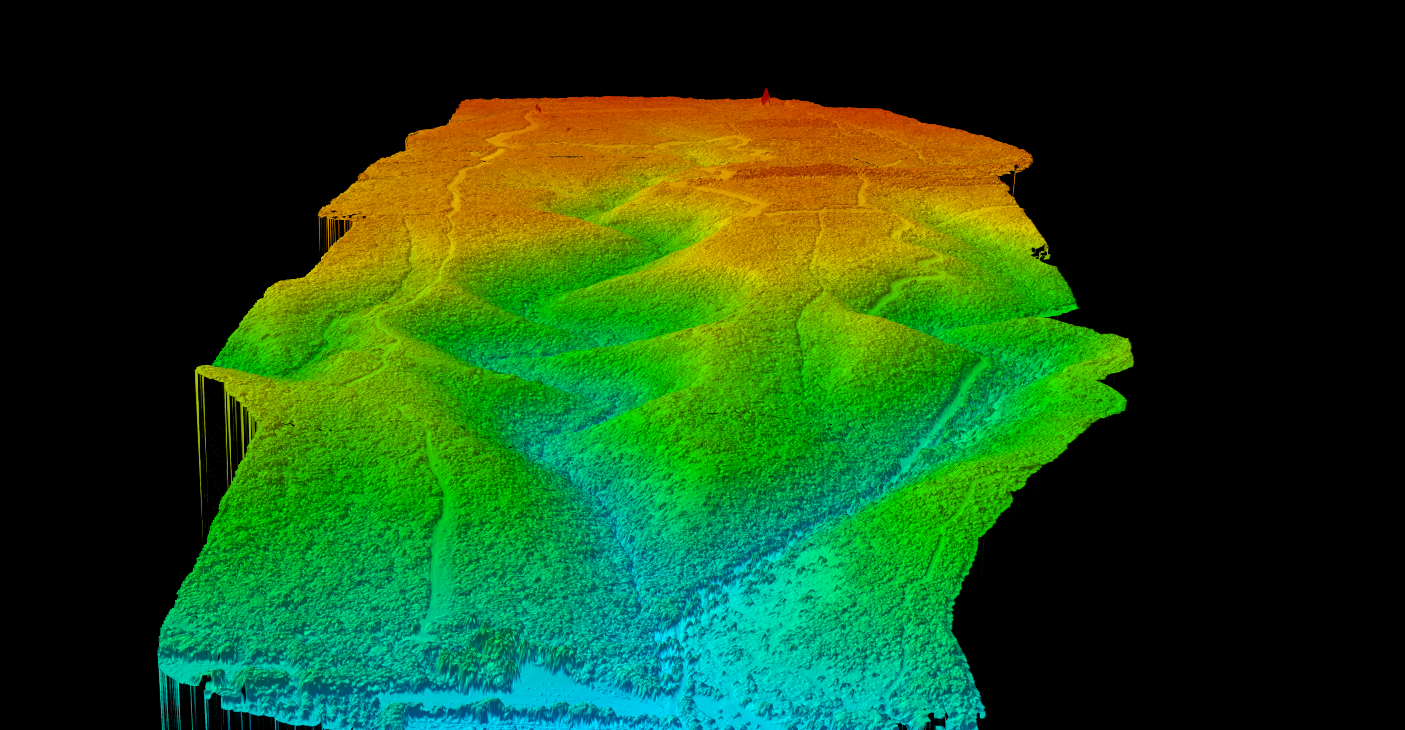
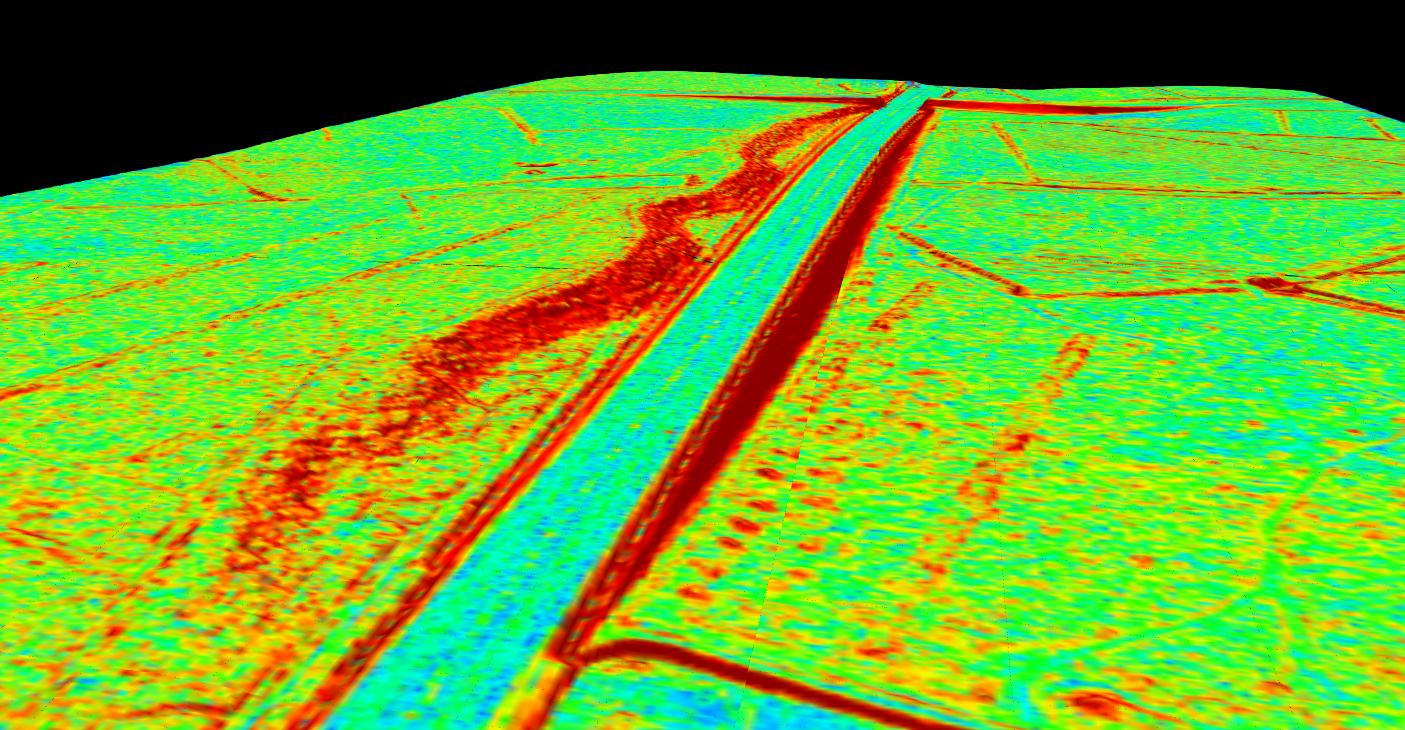
- Product generation: Create DTM, DSM, contours, and vector features
Modern cloud-based platforms automate much of this processing, transforming weeks of manual work into hours of automated analysis.
Best Practices for Successful LiDAR Acquisition
Frequently Asked Questions
How much does LiDAR data acquisition cost?
Costs vary significantly based on project size, required accuracy, terrain complexity, and mobilization distance. Airborne surveys typically range from $150-500 per square kilometer for large projects, while drone surveys may cost $500-2,000 per day plus processing fees.
What is the difference between LiDAR and photogrammetry data acquisition?
LiDAR actively emits laser pulses and measures return times, while photogrammetry derives 3D information from overlapping photographs. LiDAR penetrates vegetation, works in low light, and provides direct elevation measurements. Photogrammetry captures rich color information and may be more cost-effective for surface mapping.
What accuracy can I expect from LiDAR data?
Modern airborne systems achieve 5-10 cm vertical accuracy and 20-30 cm horizontal accuracy. Drone systems can reach 3-5 cm vertical accuracy under optimal conditions. Ground-based scanners achieve millimeter-level precision.
Do I need ground control points for LiDAR surveys?
While modern GNSS/IMU systems can achieve good absolute accuracy without ground control, GCPs improve reliability and enable accuracy verification. Most professional surveys include ground control for quality assurance.
LiDAR data acquisition forms the foundation for countless applications in surveying, engineering, environmental science, and urban planning. Understanding the acquisition process, from project planning through quality control, helps ensure your data meets project requirements and delivers reliable results.
As processing technology advances, the barrier between raw acquisition and actionable insights continues to shrink. Cloud-based platforms now automate classification, terrain modeling, and feature extraction that once required specialized expertise and expensive software.
Ready to process your LiDAR data? LidarVisor provides automatic classification, DTM generation, and vectorization for aerial point clouds. Upload your LAS or LAZ files and get CAD-ready deliverables in minutes, not weeks.